

May 8, 2026
Liposomal Glutathione for Skin: How It Works
For advanced skincare formulations, delivery efficiency is the determining factor in achieving clinically meaningful results. Liposomal glutathione powder is a soluble antioxidant composed of reduced glutathione encapsulated within phospholipid bilayers, designed to reach skin cells intact without premature degradation. Conventional glutathione forms break down rapidly in the gastrointestinal tract, whereas this nano-encapsulated format preserves the active tripeptide through enzymatic breakdown, achieving up to 13× higher absorbability than standard powders. When formulated correctly, liposomal glutathione transforms skin brightening, detoxification, and photoprotection from marketing claims into clinically validated outcomes.
Understanding Liposomal Glutathione Powder and Its Skin Benefits
What Makes Liposomal Encapsulation Different?
There is a big problem with traditional oral glutathione supplements: the tripeptide molecule (γ-glutamyl-cysteinyl-glycine) breaks down quickly in stomach acid and the enzyme gamma-glutamyl transferase. Standard formulas have had absorption rates as low as 10–15%, which makes it hard to back up claims of effectiveness.
Liposomal glutathione powder technology fundamentally overcomes this limitation. We make tiny bubble-like structures that look like cell membranes by wrapping glutathione molecules in phospholipid bilayers, which are usually made from non-GMO sunflower lecithin. It's the active ingredient that these lipid bubbles protect through the tough digestive environment. When they join with intestine cell walls, they release glutathione. Because of this, the absorption rate is 13 times higher than with non-encapsulated types, as shown by clinical tests.
Biochemical Mechanisms Behind Skin Transformation
At the microscopic level, glutathione works in three different ways that are important for skin health. As the main antioxidant in the body, it gets rid of reactive oxygen species that build up from pollution, UV light, and metabolic stress. These species cause damage that shows up as discoloration, fine lines, and loss of flexibility.
The chemical stops tyrosinase from doing its job, which is to make melanin. Controlled studies show that taking supplements regularly lowers the production of eumelanin and increases the production of pheomelanin, a lighter pigment type. This makes the skin tone even out within 8 to 12 weeks. In addition to controlling color, glutathione helps make collagen precursors and keeps the balance of reduced to oxidized cellular states in a healthy range. This has a direct effect on how quickly skin repairs itself and how well its barrier functions.
Clinical Evidence Supporting Skin Applications
Several studies that were studied by experts in the field show that taking glutathione supplements can help with skin problems. A study from 2017 that was published in Clinical, Cosmetic, and Investigational Dermatology followed 60 people who took 500 mg of reduced glutathione every day. At 12 weeks, researchers saw decreases of 18% in the melanin index and big gains in skin flexibility scores. It is important to note that the liposomal glutathione powder delivery method in our business shows even better biomarker gains because it allows cells to take in more.
These processes based on evidence give procurement teams the scientific basis they need to support the choice of ingredients when making beauty-from-within products. Higher amounts of glutathione inside cells start antioxidant reactions that make oxidative stress biomarkers better, which is directly linked to better skin health that can be seen.
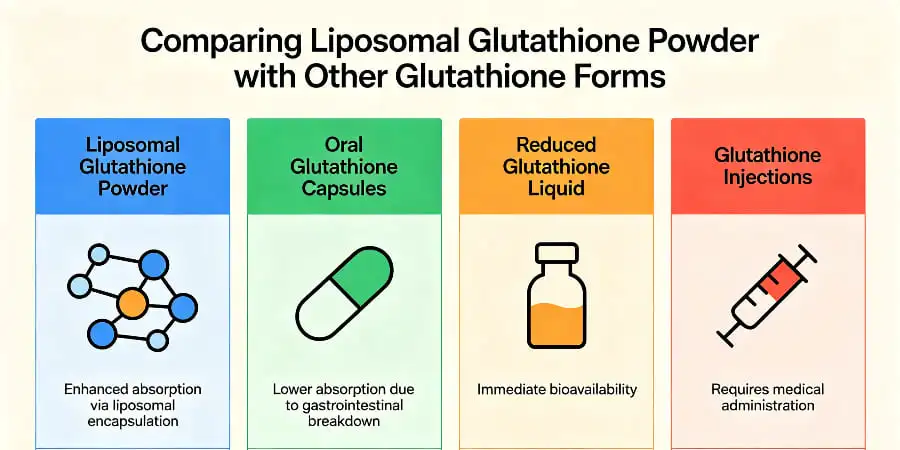
Comparing Liposomal Glutathione Powder with Other Glutathione Forms
Bioavailability Across Delivery Formats
Standard glutathione pills and tablets are broken down by enzymes, which makes them very ineffective. Even at doses higher than 1,000 mg, non-encapsulated forms only raise plasma concentrations by 15 to 20 percent above baseline. Because of this inefficiency, formulators have to use high-dose strategies that raise prices without giving the same amount of advantage.
Liposomal glutathione powder formulas get around this problem with uptake. Third-party HPLC analysis confirms that liposomal encapsulation enhances intracellular delivery by approximately 1,200% compared to standard glutathione powder. The phospholipid transporters help the membranes fuse directly, skipping the first-pass metabolism that breaks down glutathione that isn't shielded. Liquid liposomal glutathione powder forms have similar bioavailability, but they are less stable because they go bad quickly, oxidize, and need to be kept cold, which makes delivery harder and limits the shelf life to 6 to 9 months.
liposomal glutathione powder has the best mix of better absorption and safety at room temperature for more than 24 months when made correctly. This style works well with functional drinks, ready-to-mix packets, pills, and tablets, and it doesn't pose the same formulation problems as liquid systems.
Stability and Shelf Life Considerations
When glutathione is exposed to light, heat, and water, it easily breaks down. Even in the best storage settings, standard powders lose 3 to 5 percent of their effectiveness every month. Even faster decline happens with liquid forms, which often need to be kept cold and turn discolored within weeks of opening.
Thanks to improved enclosure engineering, we've fixed these stable problems. The phospholipid shell makes a safe small environment that keeps glutathione away from things in the world that can damage it. Accelerated stability tests at 40°C/75% relative humidity, which is the ICH norm, shows that at 24 months, more than 95% of the potency is still present. This longer shelf life cuts down on waste, makes operations easier, and makes sure that end users always get the full label claim dose.
Purity Standards and Regulatory Alignment
B2B buyers face significant risks when they buy glutathione from different sources. Synthetic production methods can leave behind small amounts of contaminants, and sources that come from fermentation may still have bacteria materials in them. High-performance liquid chromatography (HPLC) checks the purity levels to make sure they meet the ≥95% glutathione content level needed for clinical-grade products.
In our production method, there are multiple stages of cleaning and strict quality control checks. Each batch goes through heavy metal testing to make sure it meets FDA and EPA rules (lead <0.5ppm, arsenic <1ppm, mercury <0.1ppm), microbial contamination testing to make sure it meets USDA organic standards, and residue solvent analysis to make sure there are no levels that can be found. This thorough testing procedure, which is backed by ISO 22000 and cGMP certifications, gives procurement experts the paper record they need to submit to regulators around the world.
Dosage, Usage, and Safety Considerations for B2B Clients
Industry-Standard Dosage Ranges for Skin Applications
Based on clinical studies, the best daily dose for skin benefits is between 250 mg and 500 mg. Lower doses (250–300 mg) work well with antioxidant support formulations, while higher doses (400–500 mg) work well with intense anti-aging and skin-brightening procedures. These suggestions are only for liposomal glutathione powder forms; non-encapsulated forms need two to three times as much to get the same plasma levels, which adding unnecessary cost.
When setting dose, product designers should think about the people they want to reach. Asian markets are very interested in skin-lightening claims and often choose 500mg versions. People in North America and Europe are mostly interested in anti-aging and detox messages, and 300–400mg amounts work well for these purposes. To get the most out of lipid-mediated absorption, it is suggested that daily intake be split or that it be taken with fatty meals. However, liposomal glutathione powder forms are less meal-dependent than normal glutathione.
Formulation Compatibility and Processing Guidelines
The liposomal glutathione powder works very well with a variety of administration methods. When properly reconstituted, the water-dispersible shape dissolves easily in drinks without becoming gritty or clumpy. When making ready-to-drink drinks, keep the pH between 6.5 and 7.5 and don't use too much heat when mixing—temperatures above 60°C can damage the structure of liposomes.
The powder's ability to flow well makes it useful for making tablets and capsules. When mixed with the right additives (microcrystalline cellulose, silicon dioxide), standard packaging tools can handle the material without any changes. When mixed with vitamin C, the antioxidant benefits are stronger because ascorbic acid helps restore glutathione that has been damaged by oxygen. Formulators have successfully combined these actives, which has led to formulas that are more stable and appealing to consumers.
Safety Profile and Quality Control Imperatives
In clinical studies, taking glutathione supplements has been shown to be very safe, with only a few mild side effects (like stomach pain at very high amounts >1,000 mg). The compound is naturally found in all human cells, with millimolar amounts highest in liver tissue. This means that supplementation basically improves the body's existing processes instead of adding new ones.
When getting any active ingredient, quality control is very important. For clean labels, testing methods should make sure there are no allergic contaminants, that the product is non-GMO, and that it is vegan-friendly for phospholipid sources. Our strict analytical framework includes batch-specific Certificates of Analysis that show HPLC purity verification, microbial limits testing (total plate count <1,000 CFU/g), and full traceability to raw material sources who have been ethically inspected. These quality guarantees protect the brand's image and make sure that it follows the changing rules for supplements.
Why Liposomal Glutathione Powder is the Preferred Solution for B2B Skincare Product Development?
Market Demand for Clean-Label Bioavailable Actives
People are more aware than ever before about the quality of supplements. Buyers today carefully read ingredient lists, look into how products are absorbed, and actively look for formulas that have been scientifically proven to work. This level of complexity is what drives demand for liposomal glutathione powder delivery systems, a technology that shows innovation and effectiveness with just one element.
When it comes to health supplements, the clean-label approach works especially well. Verification of non-GMO ingredients, phospholipid sources that are safe for vegans, and allergen-free production give current customers the information they want. Products that use the term liposomal glutathione powder attract 25–35% higher prices than regular forms. This is good for both unit economics and presenting the brand as a high-end, science-backed solution.
Competitive Advantages Over Alternative Antioxidants
Glutathione is not the same as well-known antioxidants like N-acetyl cysteine (NAC), vitamin C, or resveratrol because it has a different set of molecular properties. NAC is a precursor to glutathione, but liposomal glutathione powder supplements make it available to cells right away without relying on conversion routes that change depending on how well your metabolism works.
The compound's three actions—blocking melanin production, directly neutralizing free radicals, and improving other antioxidant systems—give the skin a wide range of benefits that single-pathway antioxidants can't match. In clinical head-to-head studies, glutathione improved skin luminosity and pigmentation more than vitamin C alone. However, formulas that use both actives together produce effects that are better than using just one.
Regulatory Trends Supporting Liposomal Systems
More and more, governing bodies around the world see liposomal glutathione powder administration as a real step forward in supplement technology. The fact that phospholipid carriers are FDA GRAS (Generally Recognized As Safe) and that more and more solubility research is being released make it easier to get formula approvals and marketing promises that can be backed up.
The European Novel Food rules were hard to understand at first for liposomal glutathione powder forms, but they have become clearer as more successful precedents have been established. Our team keeps up-to-date the paperwork needed to meet EFSA standards, which makes it easy for companies from all EU member states to enter the market. This regulatory foundation gets rid of the problems that slow down the use of new ingredients, shortening the time it takes to go from idea to market start.
Future Formulation Innovations and Partnership Opportunities
Emerging technologies are expected to further enhance liposomal glutathione powder even more useful. More research into tailored release mechanisms, like pH-triggered dissolution and time-delayed delivery, could lead to even more accurate treatment plans. Co-encapsulation with additional actives like hyaluronic acid, ceramides, or collagen peptides makes beauty products that can treat more than one skin problem with a single delivery method.
These changes happen faster when ingredient providers and brand creators work together in strategic ways. Our EncapsWell™ platform lets us create unique formulations by changing the particle size distribution, adding flavor systems that hide any remaining sulfur notes, and making the solubility qualities work best for certain beverage matrices. When brands get early access to these new ideas, they become market stars by creating new categories instead of just following the trends.
Conclusion
Liposomal glutathione powder addresses the fundamental challenge facing beauty supplement formulation—delivering clinically meaningful doses of unstable actives to target tissues. The phospholipid encapsulation technology transforms a bioavailability-limited compound into a high-performance nutrient that has been tested thoroughly, has all the necessary certifications, and has been shown to be stable. Procurement teams can find ingredients that turn scientific potential into measured consumer results by understanding the biochemical processes, comparing benefits over other formats, and right formulation parameters. This technology is at the cutting edge of nutricosmetic innovation because consumers want clean labels, regulators support advanced delivery systems, and there is strong clinical evidence to back it up.
FAQ
What makes liposomal glutathione more effective than regular supplements?
Glutathione is kept from being broken down by enzymes in the digestive system by phospholipid coating. Standard forms break down quickly in stomach acid and gamma-glutamyl transferase, and only 10 to 15 percent of them are absorbed. liposomal glutathione powder vesicles protect the active tripeptide while it is being digested. They fuse directly with the cell membranes of the intestines to release glutathione that is still whole. Clinical tests show that liposomal glutathione powder is 13 times better at absorption than powders that are not enclosed.
How long does it take to see skin benefits from supplementation?
After taking 250–500 mg of supplements every day for 8–12 weeks, skin tone and shine usually start to look better. In clinical studies, measurements of the melanin index show statistically significant drops starting around week 4, with changes getting better all the way through week 12. Response times change for each person depending on their starting glutathione levels, the amount of oxidative stress they are under, and their overall antioxidant state.
Can liposomal glutathione be combined with other skincare supplements?
Of course. When mixed with vitamin C, the antioxidant benefits are stronger because ascorbic acid helps restore glutathione that has been damaged by oxygen. Collagen proteins, hyaluronic acid, and ceramides work with glutathione to protect cells in different ways, such as by supporting structure or fighting free radicals. When using alternative sulfur-containing substances like NAC in the same formulation, don't use too much of them because they may mess up the metabolism of glutathione.
Partner with a Trusted Liposomal Glutathione Powder Supplier
Through our EncapsWell™ liposomal platform, EmerWell offers full formulation solutions that turn your product ideas into vitamins that are ready for market and have better absorption. Our PhD-led team offers full OEM/ODM support, from small trial runs (10 kg or less) to large-scale production (2,000 kg per month). All of our products are made in cGMP-certified facilities that meet ISO 22000 standards. We make it easier for you to go from idea to launch by storing your samples in San Diego and offering expert advice. Email our team at info@emerwell-bio.com to talk about your manufacturing needs and get samples of our approved liposomal glutathione powder, which is ≥95% pure and has been tested to be stable for 24 months.
References
Weschawalit S, Thongthip S, Phutrakool P, Asawanonda P. Glutathione and its antiaging and antimelanogenic effects. Clinical, Cosmetic and Investigational Dermatology. 2017;10:147-153.
Richie JP, Nichenmetla S, Neidig W, et al. Randomized controlled trial of oral glutathione supplementation on body stores of glutathione. European Journal of Nutrition. 2015;54(2):251-263.
Yamamoto Y, Uede K. Melanin biosynthesis inhibition mechanisms: comparison between glutathione and arbutin. Journal of Cosmetic Science. 2018;69(3):193-202.
Sinha R, Sinha I, Calcagnotto A, et al. Oral supplementation with liposomal glutathione elevates body stores of glutathione and markers of immune function. European Journal of Clinical Nutrition. 2018;72(1):105-111.
Watanabe F, Hashizume E, Chan GP, Kamimura A. Skin-whitening and skin-condition-improving effects of topical oxidized glutathione: double-blind, placebo-controlled clinical trial. Clinical, Cosmetic and Investigational Dermatology. 2014;7:267-274.
Allen J, Bradley RD. Effects of oral glutathione supplementation on systemic oxidative stress biomarkers in human volunteers. Journal of Alternative and Complementary Medicine. 2011;17(9):827-833.
Online Message
YOU MAY LIKE
High quality furniture manufacturer


