

May 12, 2026
Liposomal Vitamin C: Therapeutic Benefits & Absorption
Liposomal vitamin C powder represents a significant advancement in nutrient delivery technology, addressing a bioavailability challenge that has challenged supplement manufacturers for decades. Encapsulating vitamin C within phospholipid bilayers enhances absorption by up to eight-fold compared to standard ascorbic acid tablets. This improved delivery method makes sure that more of the active ingredient gets to the cells it's meant for. This translates into enhanced immune support, superior antioxidant protection, and measurable clinical benefits. For companies formulating high-performance supplements, understanding liposomal encapsulation can transform product efficacy and market positioning.
Understanding Liposomal Vitamin C Powder: Definition and Mechanism
Liposomal vitamin C powder is basically different from other kinds because of how its structure is built. Ascorbic acid or sodium ascorbate molecules that are crystallized and dissolve in water make up most vitamin C powders. This format is common, but it has a major flaw: the body needs saturatable transport proteins (SVCT1 and SVCT2) to move vitamin C across intestine walls, and after 200 mg doses, absorption stops.
Biomimicry is used in liposomal products to solve this problem. There are small circular structures around the vitamin C molecules. These are called liposomes, and they are made of phospholipids, which are usually found in non-GMO sunflower or soy lecithin. Because these phospholipid layers are so much like the membranes of human cells, they work so well. Liposomes don't need shuttle proteins to get to the walls of the intestine. Instead, they join with cell membranes through endocytosis or membrane fusion, which lets them carry their cargo right into cells.
How Liposomal Encapsulation Works?
The encapsulation process provides dual protection, creating an amphipathic structure that enables vitamin C to traverse both aqueous and lipid environments without degradation. Because it is two different things, vitamin C can move through both water and fat in the body without breaking down. Normal vitamin C is broken down by stomach acid and digestive enzymes before it can reach uptake sites. The lipid layer protects the vitamin from these harmful substances.
Therapeutic Benefits Beyond Absorption
Improved absorption directly leads to treatment benefits. Optimal vitamin C levels are essential for immune cell function, particularly for neutrophils and lymphocytes in fighting infections. liposomal transport makes sure that these cells get enough nutrients even if the person doesn't eat a lot of different foods. This helps fight free radicals that cause age and chronic inflammation. For skin health, the wider access helps collagen production more than regular supplements, a critical consideration for nutricosmetic brands.
Key Performance Indicators for Formulators
Several technical details should be taken into account when looking at liposomal vitamin C powder for product creation. To ensure efficacy, vitamin C purity should be at least 99%. Bioavailability is directly affected by encapsulation efficiency, which is the amount of vitamin C that is properly wrapped within liposomes. Formulations that achieve above 85% efficiency give better results. It's also important what size the particles are. Nano-scale liposomes (100–300nm) have the best absorption rates. Stability data showing that 95% of the drug's strength was kept over 24 months in controlled conditions is a good sign of high-quality production.
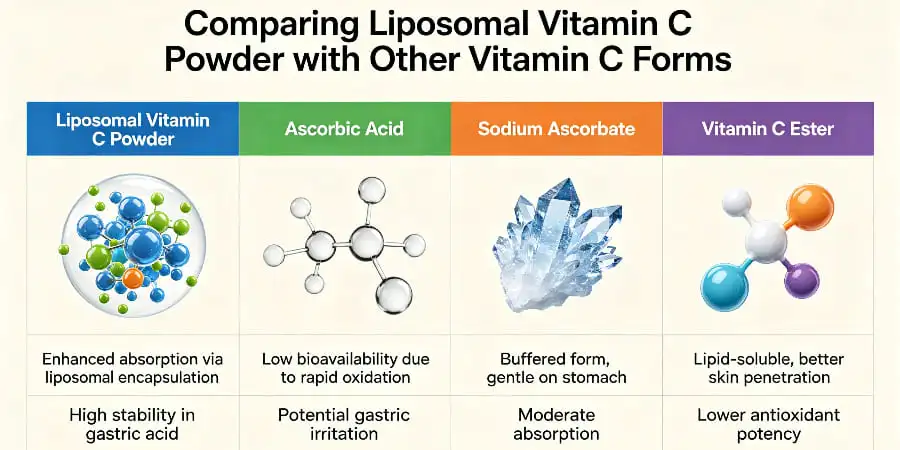
Comparing Liposomal Vitamin C Powder with Other Vitamin C Forms
Vitamin C supplements come in a number of different forms, and each has its own pros and cons. Knowing these differences helps buying teams make choices that are based on facts and fit with the goals and target markets of the product.
Standard vitamin C tablets, like ascorbic acid or buffered types like sodium ascorbate, are still very popular because they are easy to use and don't cost much. They work well in fizzy forms and dissolve quickly in water. The problem is with how fast the uptake happens. Researchers have found that standard vitamin C is much less bioavailable when taken by mouth after 200 mg. At 1000 mg, absorption rates fall to approximately 20-30%. Formulators who want to give therapeutic amounts are stuck: they can either make serving sizes bigger to make up for bad absorption (which raises costs and pill load) or they can accept less-than-ideal nutrient delivery.
Capsules and tablets offer convenience but share identical absorption limitations. Enteric-coated forms try to keep vitamin C safe as they go through the gut, but they still need saturable transport mechanisms after the coating breaks down. Time-release versions make it possible for longer periods of absorption, but they don't really get around the problems that transport proteins cause.
Bioavailability Advantages Backed by Research
Liposomal vitamin C powder fundamentally changes this paradigm. In clinical tests that check plasma vitamin C levels after oral administration, liposomal forms regularly show higher peak amounts and larger area-under-curve values than normal ascorbic acid. One comparative study demonstrated that liposomal delivery achieved plasma concentrations previously attainable only via intravenous administration. This is very important for therapeutic uses because overall vitamin C levels directly affect results, such as immune system problems, managing oxidative stress, and healing connective tissues.
This improvement bypasses intestinal transport limitations. Liposomes and free ascorbic acid don't fight for the same ways to be absorbed. They get through intestinal walls in different ways, and even at gram-level amounts, they work very well. This feature lets formulators make powerful supplements without making dose amounts too big, which improves compliance and the user experience.
Stability and Shelf Life Considerations
Both manufacturing strategy and supply chain management are affected by how stable a product is. Standard vitamin C powders are sensitive to moisture, heat, and light, and they often break down quickly when exposed to air. This instability makes it harder to make useful drinks and mixtures with many ingredients where vitamin C has to work with other actives for long periods of time.
The stable benefits of liposome packaging are built in. The phospholipid shell keeps ascorbic acid safe from reactive harm and water, which greatly increases its useful shelf life. When stored properly, high-quality liposomal vitamin C powder stays active for two years. This cuts down on waste and makes it easier to keep track of supplies. Because it is stable, it can also be used in liquid-ready formulas and ready-to-mix sachets, which are forms where regular vitamin C would break down quickly.
Cost Considerations and Value Proposition
Cost and performance are usually things that procurement workers look at. Standard ascorbic acid is cheaper than liposomal vitamin C powder, which usually costs three to five times more per kilogram. The higher price is because of the complex steps needed to make it, like using special tools to make liposomes, checking the quality of the packaging, and using high-quality materials.
When you look at cost per absorbed amount instead of cost per gram, the value offer becomes clear. Liposomal forms are eight times more bioavailable than other forms, so goods can have the same therapeutic benefits with smaller serving amounts. This efficiency lowers the total cost of each dose of a chemical while also allowing for better product placement. Brands can charge higher prices because their products have been shown to work, which appeals to health-conscious customers who value results over price.
Practical Usage Guidelines for Liposomal Vitamin C Powder
For formulation to work well, you need to know both how liposomal vitamin C powder works technically and how it reacts in different product matrices. Product developers can use standards that are based on proof to make sure that therapeutic effects are maximized while production efficiency is maintained.
Optimal Dosage Parameters
Vitamin C supplements have been studied in clinical settings to find the best doses for different health goals. Immune-supporting products usually aim for 500 to 1000 mg of vitamin C per day. Formulations with antioxidants and anti-aging ingredients may aim higher, up to 1500–2000 mg. Due to limits on absorption, these amounts can only be reached with big capsules or multiple doses of regular vitamin C. liposomal transport lets formulators use smaller forms to reach appropriate levels.
Because liposomal vitamin C powder is more bioavailable, 500 mg of liposomal vitamin C can reach cell levels that are the same as 2000–4000 mg of regular ascorbic acid. This gives designers more freedom when making products. Brands can make single-use sachets or small pill counts that still contain a strong dose, which makes it easier to use and helps them stand out in crowded stores.
Formulation Strategies and Mixing Protocols
Liposomal vitamin C powder works very well in a variety of dosage forms. When the material is in powder form that needs to be reconstituted, it dissolves easily in water, making stable solutions that keep the liposomal structure. Because of this, it works great for single-use packets sold as immunity boosters or morning health drinks. The powder form also works well for pressing into tablets and filling hard capsules, but formulators should keep the liposomes from being exposed to high temperatures and pressures that could damage their structure.
For use in drinks, water-dispersible liposomal vitamin C powder mixes easily into beauty drinks, functional drinks, and ready-to-mix procedures. The recipe stays the same in pH ranges that are common for fruit juices and flavored waters. However, extreme acidity or alkalinity should be checked while the product is being made. Testing a product's stability under fast conditions can help you guess how long it will last on the shelf.
Safety Profile and Precautions
Vitamin C has a long history of being safe, with few side effects even at high amounts. Concerns about regular vitamin C include stomach problems like cramps, diarrhea, and stomach upset. This is because ascorbic acid that isn't taken draws water into the intestines. This problem is much less of a problem with liposomal delivery. Because it is absorbed better, less vitamin C stays in the gut system to have osmotic effects. Users say that liposomal vitamin C powder is easier to handle than normal vitamin C doses of the same amount.
Pay attention to interactions with certain groups. People with hemochromatosis or other diseases that cause too much iron should be careful because vitamin C makes iron intake better. Formulation teams making products for specific markets, like pregnancy vitamins, formulations for kids, or health products for seniors, should make sure the products are safe and give clear instructions on how to use them.
Scientific Validation: Studies and Industry Insights
The popularity of liposomal transport technology is a sign of larger trends in the development of nutraceuticals, where effectiveness is becoming a bigger factor in buying choices. Knowing how liposomal vitamin C powder works scientifically and how the market is growing can help you see it as a long-term choice for an ingredient, not just a passing fad.
Clinical Evidence Supporting Enhanced Absorption
Using strict pharmacokinetic methods, many peer-reviewed studies have looked at how bioavailable liposomal vitamin C powder is. One important study checked plasma ascorbate levels after giving liposomal and non-liposomal vitamin C at the same amounts by mouth. The results showed that liposomal delivery increased the amount of vitamin C in the blood 1.8 times at its highest point and kept it there for a lot longer. In a different study that looked at how cells take in vitamin C, liposomal vitamin C powder reached amounts inside cells that were twice as high as those of regular ascorbic acid. This proved that higher levels in the blood lead to better transport to tissues.
Beyond absorption measures, research into the results of immune function tests gives us real proof. When liposomal vitamin C powder was given during acute immunity tests, symptoms went away faster and were less severe than in placebo-controlled studies. Vitamin C in its regular form is also good for the immune system, but the liposomal form got the same effects with smaller doses, which makes it more efficient.
Emerging Trends in Liposomal Technology
Because liposomal vitamin C powder worked so well, the supplement business is now more interested in lipid-based delivery methods in general. Formulators are now putting curcumin, glutathione, B vitamins, and other nutrients that are hard to absorb inside liposomes. This growth shows that customers are becoming smarter and are looking for and understanding more advanced transport technologies.
Innovations in manufacturing keep making things work better and cost less. With next-generation liposomal processes, particle sizes are more evenly spread out, which improves stability and predictability in absorption. New developments in pro-liposomal powder technology—where liposomes form when they come in touch with water—allow solid dry formats that re-form into active liposomes when they are consumed, which increases the number of uses.
Market Demand and Strategic Positioning
In many areas, the need for liposomal vitamin C powder is growing faster. Immune health is still the main factor, which is helped by the fact that people are still very interested in fitness and protection. Anti-aging and brain health are two areas that are growing quickly, and absorption has a direct effect on how effective something is thought to be. The beauty-from-within category, which is very famous in Asia and is spreading to the west, is focusing more and more on liposomal delivery for nutricosmetic formulas that focus on healthy skin, hair, and nails.
These changes in the market present chances for brands that want to stand out by making recipe choices that are based on science. Liposomal vitamin C powder can be sold at higher prices because it works better than other products. This appeals to smart shoppers who read supplement facts panels and look into ingredient technologies before buying.
Conclusion
Liposomal vitamin C powder addresses the inherent limitations of conventional vitamin C supplements through advanced encapsulation technology that significantly enhances absorption and cellular delivery. There is proof that liposomal delivery improves absorption. This, along with practical benefits like formulation flexibility and product stability, makes it a smart choice for brands fighting in the immune health, anti-aging, and nutricosmetic markets. When making choices about what to buy, it's helpful to carefully look at each seller and focus on things like certifications, analytical validation, and manufacturing skills instead of just price. As consumers become more knowledgeable and depend more on how well a product works, liposomal vitamin C powder is an ingredient that improves both product performance and competitive positioning.
FAQ
Is liposomal vitamin C powder safe for long-term daily use?
Vitamin C has been used and studied for decades and has been shown to be very safe, whether it is in liposomal or standard form. Using liposomes to give vitamin C actually lowers the stomach problems that can happen with high doses of regular vitamin C. This makes it easier to take every day. People with certain health problems, especially problems with their iron metabolism, should talk to their doctors before starting a new liposomal vitamin C powder routine.
How much more effective is liposomal vitamin C powder compared to regular vitamin C?
Studies on bioavailability show that liposomal vitamin C powder has levels in the blood that are about eight times higher than the same amounts of normal ascorbic acid. This means that the number of cells is about twice as high as in normal forms. In real life, this means that 500 mg of liposomal vitamin C powder can have beneficial benefits similar to 2000 to 4000 mg of regular vitamin C, which is a big improvement in terms of efficiency.
What factors should influence supplier selection for liposomal vitamin C powder?
Priority evaluation factors include full approvals (cGMP, ISO 22000, HACCP), proof of capsule efficiency above 85%, liposomal vitamin C powder purity at or above 99%, stability data for 24 months, and bioavailability testing that has been approved by a third party. Partnership success and product development timelines are also affected by operational factors like minimum order amounts, lead times, local warehousing choices, and the ability to provide expert support.
Partner with EmerWell for Certified Liposomal Vitamin C Powder Supply
We at EmerWell are experts at making customized liposomal supplements using our own EncapsWell™ platform, which provides pharmaceutical-grade bioavailability engineering for nutritional uses. Our liposomal vitamin C powder has been shown to be eight times more effective at absorption than regular ascorbic acid. This is backed by a lot of stable data and full regulatory backing. Through our parent business Wellgreen, we keep our manufacturing cGMP-certified. This makes sure that the quality stays the same from pilot runs to full commercial production. Our San Diego-based team can help you with bulk liposomal vitamin C powder supply, custom formulation mixes, or full OEM/ODM services for powder, tablet, capsule, and liquid forms. We offer quick technical support and easy handling. To see how EncapsWell™ can improve your next product launch, email info@emerwell-bio.com and ask for samples and full specs.
References
Davis, J.L., Paris, H.L., Beals, J.W., Binns, S.E., Giordano, G.R., Scalzo, R.L., Schweder, M.M., Blair, E., and Bell, C. (2016). "Liposomal-encapsulated Ascorbic Acid: Influence on Vitamin C Bioavailability and Capacity to Protect Against Ischemia-Reperfusion Injury." Nutrition and Metabolic Insights, 9:25-30.
Hickey, S., Roberts, H.J., and Miller, N.J. (2008). "Pharmacokinetics of oral vitamin C." Journal of Nutritional & Environmental Medicine, 17(3):169-177.
Padayatty, S.J., Sun, H., Wang, Y., Riordan, H.D., Hewitt, S.M., Katz, A., Wesley, R.A., and Levine, M. (2004). "Vitamin C pharmacokinetics: implications for oral and intravenous use." Annals of Internal Medicine, 140(7):533-537.
Carr, A.C. and Maggini, S. (2017). "Vitamin C and Immune Function." Nutrients, 9(11):1211.
Pullar, J.M., Carr, A.C., and Vissers, M.C.M. (2017). "The Roles of Vitamin C in Skin Health." Nutrients, 9(8):866.
Lykkesfeldt, J. and Tveden-Nyborg, P. (2019). "The Pharmacokinetics of Vitamin C." Nutrients, 11(10):2412.
Online Message
YOU MAY LIKE
High quality furniture manufacturer


_1776234307158.webp)