

May 12, 2026
What Makes Liposomal NAD+ Powder More Effective?
Liposomal NAD+ powder achieves superior effectiveness through advanced encapsulation technology that protects nicotinamide adenine dinucleotide molecules within phospholipid bilayers. This formulation overcomes the primary limitation of standard NAD+ supplements—poor oral bioavailability caused by enzymatic degradation in the gastrointestinal tract. By shielding the active compound during digestion and facilitating direct cellular membrane fusion, liposomal delivery systems can increase absorption rates by 5-10 times compared to conventional powders. This translates into measurable improvements in cellular NAD+ levels, which is essential for energy metabolism, DNA repair, and longevity pathways.
Understanding Liposomal NAD+ Powder and Its Effectiveness
The Science of Liposomal Encapsulation Technology
There is a complex way to give nutrients called liposome encapsulation that works like the body's own cells. This technology uses very small spherical spheres made of phospholipid walls, which are usually made from non-GMO sunflower or soy lecithin and protect NAD+ molecules. The width of these vesicles is usually between 50 and 80 nanometers, which is the best size range for stability and cell uptake. When you take liposomal NAD+ powder that has been mixed with fluids or made into a vitamin, these lipid carriers pass through your digestive system very easily. The phospholipid bilayer structure is a lot like the membranes of human cells. This lets the liposomes join directly with intestine epithelial cells through a process called membrane fusion, skipping the harsh enzyme environment that breaks down NAD+ that is not protected.
How Bioavailability Challenges Are Solved?
Traditional NAD+ medicines have a hard time getting to optimal levels in the blood. According to research, stomach enzymes quickly break down NAD+ molecules that are not enclosed, and the liver does a lot of first-pass metabolism, which means that bioavailability rates are often below 15%. NAD+'s big molecular size (663 Da) and the fact that it is charged make passive passage across intestinal membranes even harder. Liposomal formulations deal with these problems in several ways. The lipid envelope protects against enzymatic hydrolysis, the nanoscale particle size makes lymphatic absorption easier (bypassing hepatic metabolism), and the biomimetic structure encourages endocytosis, a cellular process that actively moves the encapsulated compound into systemic circulation. Comparative studies of absorption show that liposomal delivery gets peak plasma concentrations that are 3–8 times higher than similar amounts of normal powder formulations. The longer circulation time keeps NAD+ levels high for longer periods of time.
Cellular Uptake Mechanisms That Drive Results
The best way to tell how well something works is to look at how much NAD+ is inside cells, which is where the coenzyme does its important work. Once liposomal carriers get into the bloodstream, they move to different parts of the body and communicate with specific cells. Liposomes can attach to cell walls of different types of tissues, like muscle, liver, and neural cells, thanks to their phospholipid makeup. This lets them transfer their NAD+ payload straight into the cytoplasm. This specific transport method works especially well for mitochondrial function, since NAD+ needs to get to these energy-producing parts of cells to help make ATP and use energy. In vitro tests on cellular uptake show that properly designed liposomal systems work more than 90% of the time, while free NAD+ molecules trying to cross cell membranes on their own only work about 20% of the time. Because liposomal NAD+ powder products can improve indicators linked to NAD+ sufficiency at much lower amounts than standard supplements, this big difference in cellular penetration makes sense.
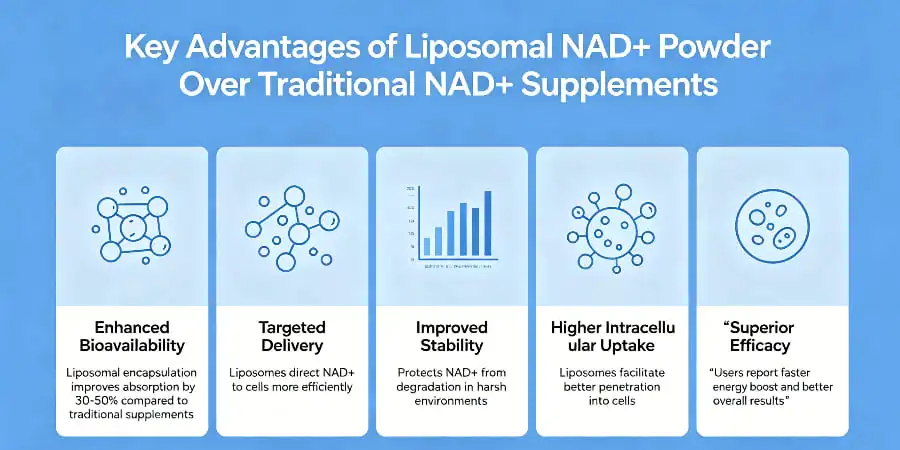
Key Advantages of Liposomal NAD+ Powder Over Traditional NAD+ Supplements
Superior Absorption Efficiency Validated by Data
The absorption benefit of liposomal NAD+ powder goes beyond just being good in theory. It can be measured in ways that are useful for product development. Standardized bioavailability testing using Caco-2 cell models—the best way to guess how well something will be absorbed by the intestines—shows that liposomal NAD+ is 5-10 times better at transporting than solid NAD+ powder. In the right formulation, with the right amounts of phospholipids and particle sizes, these systems can withstand the acidic environment of the stomach (pH 1.5-3.5) and release their contents exactly where absorption works best, in the small intestine. Quality liposomal NAD+ powder formulations dissolve easily in water, which lets them be easily mixed with liquids for use in drinks or directly put into different dose forms without damaging the protective liposomal structure. Because of this, formulators can get uniform bioavailability in a variety of product forms, such as pills, sachets, ready-to-drink drinks, or functional food matrices. This means that the products will always work, no matter how they are delivered.
Stability Advantages That Protect Your Investment
When exposed to heat, light, dampness, and oxidative conditions, raw NAD+ molecules are notoriously unstable. This makes it very hard to make new products and control their shelf lives. Under normal storage settings, NAD+ powder that is not covered can lose 30 to 40 percent of its effectiveness in six months. Liposomal encapsulation makes stability much better by keeping NAD+ away from external factors inside a safe lipid matrix. High-quality liposomal NAD+ powder forms keep more than 90% of their potency for 24 months at room temperature, so they don't need to be kept cold, which makes operations and store distribution more difficult. The lyophilized powder format makes it even more stable by getting rid of moisture, which is a major cause of degradation processes. It also keeps the liposomal structure in a dormant state that fully reconstitutes when it gets wet. This advantage of stability cuts down on waste from old stock, increases spread to more climate zones, and boosts customer trust by ensuring consistent product performance throughout the entire shelf life.
Comparative Positioning Against Alternative NAD+ Precursors
There are a number of different methods to NAD+ therapy, and each has its own pros and cons. Formulators who want to give the active coenzyme itself rather than intermediates that need to be changed by enzymes like direct NAD+ supplementation. Nicotinamide riboside (NR) and nicotinamide mononucleotide (NMN) are good NAD+ boosters, but they rely on cellular enzyme systems (NRK and NMNAT pathways) that may work less well in some people and less well as they get older. Liposomal NAD+ powder fills the gap between NR and NMN's baseline absorption and, in properly formulated systems, meets or beats these precursors' bioavailability while providing the final product directly. Injectable NAD+ has full solubility, but it's still not useful for household goods because it's hard to use, there are rules against it, and it costs a lot. For B2B clients who are making supplement lines for sale, liposomal NAD+ powder is the best option because it delivers NAD+ directly with absorption levels comparable to precursors, doesn't need any special handling or administration skills, and fits standard supplement formats that customers accept and that are easy for regulators to understand.
Evaluating Liposomal NAD+ Powder for Procurement—Quality, Safety, and Dosage Considerations
Safety Profile and Regulatory Compliance Standards
NAD+ has a good safety rating because it is an endogenous molecule that is found naturally in all living things. Supplemental NAD+ has been shown to be well tolerated in clinical studies at doses of up to 1000 mg per day, with no serious side effects being recorded in peer-reviewed literature. The liposomal delivery system includes phospholipids, which are generally known as safe (GRAS) substances that have been used in food and supplements for decades without raising any new safety issues. Responsible sellers make sure that the liposomal NAD+ powder they sell meets all the necessary legal standards. These standards include cGMP manufacturing processes that make sure strict quality controls are carried out throughout the production process. Products should have the right certificates, like ISO 22000 for managing food safety, FSSC 22000 for making sure the supply chain is honest, and HACCP paperwork showing that hazards are controlled in a planned way. Testing by a third party for heavy metals (like lead, cadmium, mercury, and arsenic), microbial pollution, and pesticide leftovers is an important way to make sure that the ingredients are pure. Purchasing managers should ask for certificates of analysis (COA) that show the NAD+ content meets standards (usually ≥98% purity) and that there are no adulterants or unlisted ingredients that could make the product less safe or not follow the rules in target markets.
Dosage Ranges for Different Application Categories
Dosing methods that are specifically designed for the intended uses and buyer groups must be carefully thought through in order for NAD+ supplements to work. Researchers in the field of medicine have found that taking anywhere from 125 mg to 500 mg of NAD+ every day can help with energy production and good aging. Specialized formulas for sports performance or intense healing routines may use higher amounts of 500 to 1000 mg. On the other hand, beauty-from-within products usually use 250 to 400 mg along with other active ingredients like antioxidants or collagen peptides. Because liposomal delivery is more bioavailable, formulators can get the desired physiological effects with lower absolute doses compared to standard NAD+ powder. This makes the product more cost-effective and allows for cleaner label statements because fewer excipients are needed to reach therapeutic thresholds. When making supplements for different foreign markets, keep in mind that suggested serving sizes might need to be changed to match regional rules and how people in that area normally take supplements. Working with suppliers who give dosing advice based on specific recipe situations and target groups helps improve product performance while keeping safety margins at the right level.
Quality Markers That Distinguish Premium Suppliers
When choosing a liposomal NAD+ powder provider, you need to look at more than just the product's basic specs. Certifications for manufacturing facilities give you basic peace of mind. Look for suppliers that use ISO 9001 quality management systems, keep their kosher and halal certifications to get into global markets, and get organic certifications (NOP, EOS) if you're going after premium natural product segments. Vegan and non-GMO certification meets the needs of more and more customers and increases the size of the market that can be reached. The level of sophistication of liposomal technology itself is a quality indicator. Suppliers with PhD-level scientific teams and their own encapsulation platforms usually offer better particle size consistency and encapsulation efficiency than those who use generic liposomal processes. Ask for information on the actual liposome size distribution (should be tightly clustered in the 50–80nm range with a low polydispersity index), the percentage of encapsulation efficiency (should be >85%), and the results of stability testing that follows ICH standards. A provider that is open about where their phospholipids come from, willing to provide technical support paperwork, and able to change formulations to fit specific needs is more of a development partner than just a vendor of basic ingredients.
Integrating Liposomal NAD+ Powder Into Your Product Line or Supply Chain
Formulation Versatility Across Product Categories
Liposomal NAD+ powder is very flexible and can be used in a wide range of supplement forms and situations. This makes it a desirable ingredient for formulators who work on a variety of products. Liposomal NAD+ powder that has been properly engineered can easily dissolve in water, making it easy to use in functional drinks, beauty shots, and ready-to-mix powdered drink products. It stays intact and bioavailable while dispersing evenly, not separating or settling. When making encapsulated supplements, liposomal NAD+ powder easily fits into vegetarian capsules (HPMC) or regular gelatin capsules without the need for special tools. It also has great flowability properties that allow for efficient automated encapsulation at commercial manufacturing speeds. The powder can be easily compressed and works well with common ingredients like microcrystalline cellulose, silica, and magnesium stearate. However, formulators should check to see whether direct compression or wet granulation is better at protecting the liposomal structure during tableting forces. Soft gel encapsulation makes oil-based liposomal solutions possible, which brings the benefits of the delivery platform into this famous high-end format. The ingredient has a neutral organoleptic profile, which means it has little effect on taste and smell. This makes it easier to create flavor systems and reduces the need for hiding agents, which is a big plus when making tasty functional drinks or chewable pills.
Stability and Shelf-Life Management
For supplement brands, keeping their products stable throughout the distribution chain and their shelf life at retail is very important. This is why liposomal NAD+ powder's natural stability benefits are so valuable. When you freeze a powder, the moisture that speeds up breakdown processes is taken away. The liposomal encapsulation protects NAD+ from oxidative stress, temperature changes, and light exposure, all of which can damage products that aren't protected. When kept in the right way (sealed containers, controlled humidity, and temperatures below 25°C), premium liposomal NAD+ powder stays more than 90% effective for 24 months. This is a shelf life that fits with the usual length of time for supplements to be sold in stores and gives enough time for distribution and use by customers. The overall makeup of the formulation determines how stable the finished product is. For example, ingredients that are easily oxidized, like certain oils or compounds that are sensitive to moisture, may need extra protection like nitrogen flushing, desiccant packets, or light-protective packing. When you follow the ICH procedures for accelerated stability testing, you can get information about how the product will behave in the long term and find possible degradation paths before you start making a lot of it. Responsible sellers give stability advice for different types of finished goods and can suggest stabilizer systems or packing arrangements that will give your product the longest shelf life.
Supplier Support Services That Accelerate Time-to-Market
From an idea to a market product, there are a lot of technical and legal hurdles to jump. Help from an experienced source can really make a difference. Leading liposomal NAD+ powder suppliers help with formulation development, which speeds up the innovation process. Their technical teams have knowledge of the product category, are aware of how ingredients that work well together (resveratrol, quercetin, CoQ10), and know how to keep bioavailability high during production. Customization lets brands stand out by changing portion sizes to meet specific dosage goals, adding branded flavoring systems, making multi-ingredient formulas that work well together, or making unique formulas that are covered by confidentiality agreements. Regulatory documentation help is especially helpful when entering new markets. Full dossiers with safety data, manufacturing process descriptions, quality specifications, and stability studies are the basis for product registrations and make your regulatory affairs team's job a lot easier when it comes to compliance. Analytical testing services, like method creation, stable tracking, and third-party verification testing, make sure that quality is always maintained without the need to invest in new lab equipment. Services that connect the supply chain, like contract inventory programs, just-in-time delivery schedules, and dedicated account management, make things run more smoothly and let your team focus on building the brand instead of managing logistics.
Conclusion
Liposomal NAD+ powder is a scientifically proven improvement in the technology of nutraceutical ingredients. It gives B2B sourcing workers a way to make better goods with clear bioavailability benefits. The capsule technology fixes some of the main problems with traditional NAD+ supplements while also making formulations more flexible, improving stability, and making it easier to make a wide range of product forms. To do good procurement, you need to look at providers on more than just price per unit. You should look at their technical skills, quality systems, ability to follow regulations, ability to customize products, and joint support services. When carefully added to product development plans, with care given to dosage optimization, stability management, and formulation synergies, liposomal NAD+ powder helps brands make unique products that give customers measurable benefits in the competitive market for health and longevity supplements.
FAQ
Is liposomal NAD+ powder safe for large-scale commercial production?
Liposomal NAD+ powder has a great safety rating that makes it ideal for mass production. The chemical NAD+ is found naturally and has a lot of clinical safety data. Phospholipid carriers, on the other hand, are GRAS-approved ingredients that are widely used in food and supplements. As long as the ingredient is made according to cGMP guidelines and quality controls are in place, there are no special safety issues. To make sure their products meet the safety standards for their target markets, manufacturers should check that their suppliers have the right certifications (ISO 22000, FSSC 22000, HACCP) and look over third-party tests for contaminants.
How does liposomal NAD+ compare in effectiveness to standard NAD+ capsules?
Liposomal versions are much more bioavailable than regular NAD+ capsules—studies have shown that they are usually 5–10 times more effective at absorption. Standard NAD+ is broken down a lot in the stomach track and has poor membrane permeability, which means it is not taken up by the body very much. Liposomal encapsulation saves NAD+ during digestion and makes it easier for cells to take it up directly, which results in much higher blood levels and concentrations inside cells for the same amounts.
How can I verify supplier quality and authenticity?
Check a supplier's trustworthiness using a number of quality indicators, such as looking at the production facility's certifications (cGMP, ISO standards), asking for certificates of analysis that show NAD+ is pure (≥98%), looking at third-party tests for contaminants, and checking the quality of the technical documents. Suppliers with a good reputation give full regulatory dossiers, stability data that follows ICH standards, and open conversation about how they make things and their quality systems. You could do qualification checks or ask current clients for contact information for references.
Partner With EmerWell for Premium Liposomal NAD+ Powder Solutions
EmerWell creates advanced liposomal NAD+ powder products using our own EncapsWell™ platform, which gives premium brands the best bioavailability and stability. We are an experienced manufacturer headquartered in San Diego with smart production partnerships. We offer full OEM/ODM services that are suited to your needs. Our cGMP-certified production facilities can handle anything from small test runs to commercial amounts over two tons, and our PhD-led research and development team is here to help with any technical questions you have as you work on new formulations. With a NAD+ content of at least 98%, absorption rates confirmed at 5–10× standard formulations, and stability for 24 months without cooling, our liposomal NAD+ powder gives you the tools you need to make goods that lead the market. To support global marketing, we keep a lot of certificates, such as ISO 22000, FSSC 22000, HACCP, Kosher, Halal, Non-GMO, and Vegan. Email our team at info@emerwell-bio.com to talk about custom formulations, get technical paperwork, or set up a review for your next high-end supplement idea.
References
Rajman, L., Chwalek, K., & Sinclair, D. A. (2018). Therapeutic potential of NAD-boosting molecules: The in vivo evidence. Cell Metabolism, 27(3), 529-547.
Shade, C. (2016). Liposomes as advanced delivery systems for nutraceuticals. Integrative Medicine: A Clinician's Journal, 15(1), 33-36.
Poddar, S. K., Sifat, A. E., Haque, S., Nahid, N. A., Chowdhury, S., & Mehedi, I. (2019). Nicotinamide mononucleotide: Exploration of diverse therapeutic applications of a potential molecule. Biomolecules, 9(1), 34.
Akbarzadeh, A., Rezaei-Sadabady, R., Davaran, S., Joo, S. W., Zarghami, N., Hanifehpour, Y., Samiei, M., Kouhi, M., & Nejati-Koshki, K. (2013). Liposome: Classification, preparation, and applications. Nanoscale Research Letters, 8(1), 102.
Yoshino, J., Baur, J. A., & Imai, S. I. (2018). NAD+ intermediates: The biology and therapeutic potential of NMN and NR. Cell Metabolism, 27(3), 513-528.
Has, C., Sunthar, P., & Sundaramurthy, V. (2020). A comprehensive review on recent preparation techniques of liposomes. Journal of Liposome Research, 30(4), 336-365.
Online Message
YOU MAY LIKE
High quality furniture manufacturer


_1776234307158.webp)

_1776234266736.webp)